Chain of Custody: Can Your Records Pass an Audit?
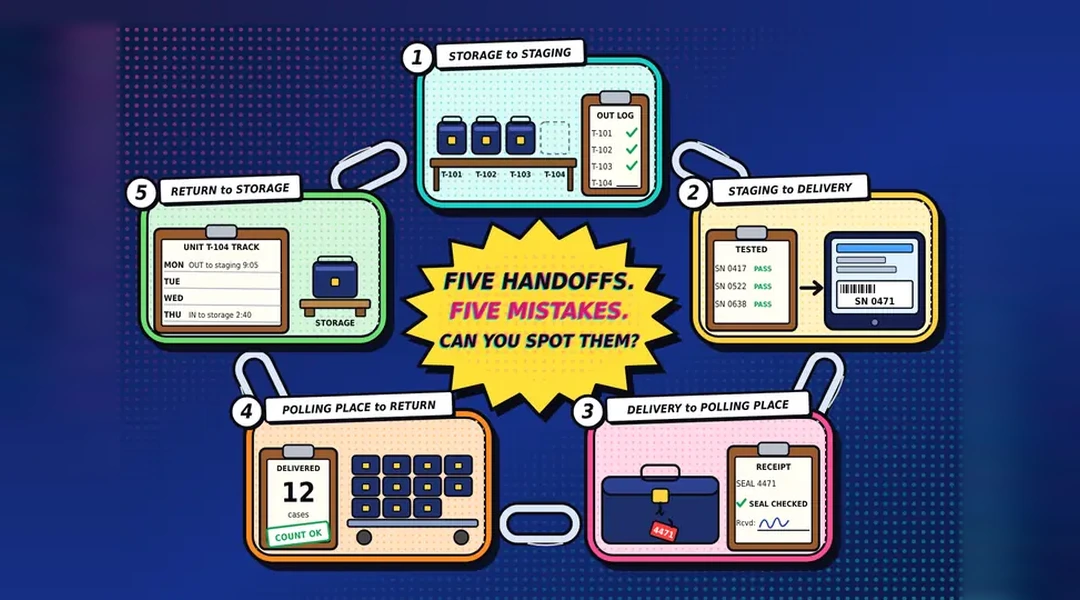
Five questions to ask your team this week, while the election is still fresh.
By Daniel Woodford
First, thank you. Whatever your election looked like this year, it took thousands of small, unglamorous decisions to get equipment where it needed to be, when it needed to be there. Most of the people who made those decisions will never be thanked in public. We haven't written here in a while, and as we start again, we wanted to begin by saying so.
Now, a question to take to your next staff meeting.
Pick any single piece of equipment from this election. A tablet, a scanner, a ballot box, a laptop, a bag of supplies. Can you show, on paper or on screen, where it was at 3:00 p.m. last Tuesday, who had it, and who saw them hand it over?
If the answer came fast, your records are doing exactly what chain-of-custody requirements ask of them. If it took a little digging, that's completely normal after a busy election, and it shows you exactly where to make your documentation even stronger.
Chain of custody sounds like a compliance term. It is closer to a simple promise: we know where this was, and we can show you. The U.S. Election Assistance Commission describes it as “the processes, or paper trail, that documents the transfer of materials from one person (or place) to the next.” The Center for Internet Security adds the part that keeps people up at night: a break in the chain is any period when control of equipment “is uncertain and during which actions taken … are unaccounted for or unconfirmed.” That’s the moment an office can no longer guarantee nothing happened. That paper trail is also your audit trail: when an auditor, an observer or a reporter asks about a device, the record is the answer.
The good news is that you don't need new software or a new budget line to find your weak spots. You need ten minutes and a pen. Here is the check.
The five handoffs
Every piece of election equipment makes roughly the same journey. Walk that journey one handoff at a time, and ask the question below at each stop.
1. Storage to staging. Equipment leaves its long-term home to be tested and prepared. Ask: Do we record exactly which units left, and in what condition?
2. Staging to delivery. Prepared equipment is loaded and sent out. Ask: Is the unit that was tested the same unit that arrives, and can we show it?
3. Delivery to the polling place. A person receives equipment that someone else prepared. Ask: Who signed for it, and did anyone check the seals or serial numbers on arrival?
4. Polling place to return. The busiest, most tired hour of the whole process. Ask: Is the return count the same as the delivery count, and where is that written down?
5. Return to storage. Equipment comes home and the clock keeps running. Ask: Who has it between the return desk and the shelf, and how soon is it logged?
What a good record contains
The EAC’s best-practice guidance is refreshingly plain. A useful record captures the election name and date, a description of each item with its serial number and condition, the date and time of every transfer, and the names and signatures of at least two witnesses. It also says that “every election office should have written chain of custody procedures available for public inspection prior to every election,” and that “the key to an effective chain of custody is to have a set of procedures which are followed in practice.”
Read that last phrase twice. Followed in practice. The best procedure is the one your team follows every day, without having to think about it.
Three places records can slip
- Gaps in time. Equipment is logged out on Monday and logged in on Thursday, and nobody can say where it spent Tuesday and Wednesday.
- Reconstruction after the fact. Records are filled in from memory days later, because the log was too slow to use in the moment.
- One name on the line. A single signature stands where two witnesses should be, usually because it was late and everyone was trusted.
None of these mean anyone did anything wrong. They are the normal pressure points of a busy election. A written habit takes the pressure off goodwill, and a record is what lets you show the care your team already takes.
Why this week is the right week
Right now your team remembers which handoffs ran smoothly and which took extra effort. In a month those stories will be gone. Capture them while they're sharp, and you'll walk into your next election with a better process, not just a good memory.
We've put the whole check on a one-page worksheet. Print it, hand it to your team, and spend ten minutes at your next meeting. Then tell us what you found. We read every reply, and we would love to hear which handoff surprised you.
About WDS
WDS has more than 36 years of warehousing and logistics experience and more than 18 years of election logistics experience, working alongside some of the nation's largest and most complex election departments, including Miami-Dade and Tarrant counties. Our team are logisticians who also write software, so what we build comes from the warehouse floor and the loading dock, not a conference room. Our TSX Elections Inventory System helps offices record where equipment, ballots and supplies are, and who has them, from warehouse to polling place and back. Think of us as the scalpel: focused on precision and logistics. Flawless elections and customer satisfaction are what we care about most. Learn more at wedoinventory.com/elections.
Sources: U.S. Election Assistance Commission, Chain of Custody Best Practices; Center for Internet Security, Election Security Spotlight: Chain of Custody is Crucial for Election Offices (cisecurity.org).